
Quick answer: Programmatic SEO is the practice of generating many search-optimized pages from a template plus a structured data source — for example “Best [tool] for [use case]” filled from a database. It still works in 2026, but only when each page adds unique data and real value; Google’s March 2026 update penalized “scaled content abuse,” where volume meets thin, near-duplicate pages. This guide covers how it works, the 2026 rules, and a step-by-step method — the same method behind our programmatic SEO service.
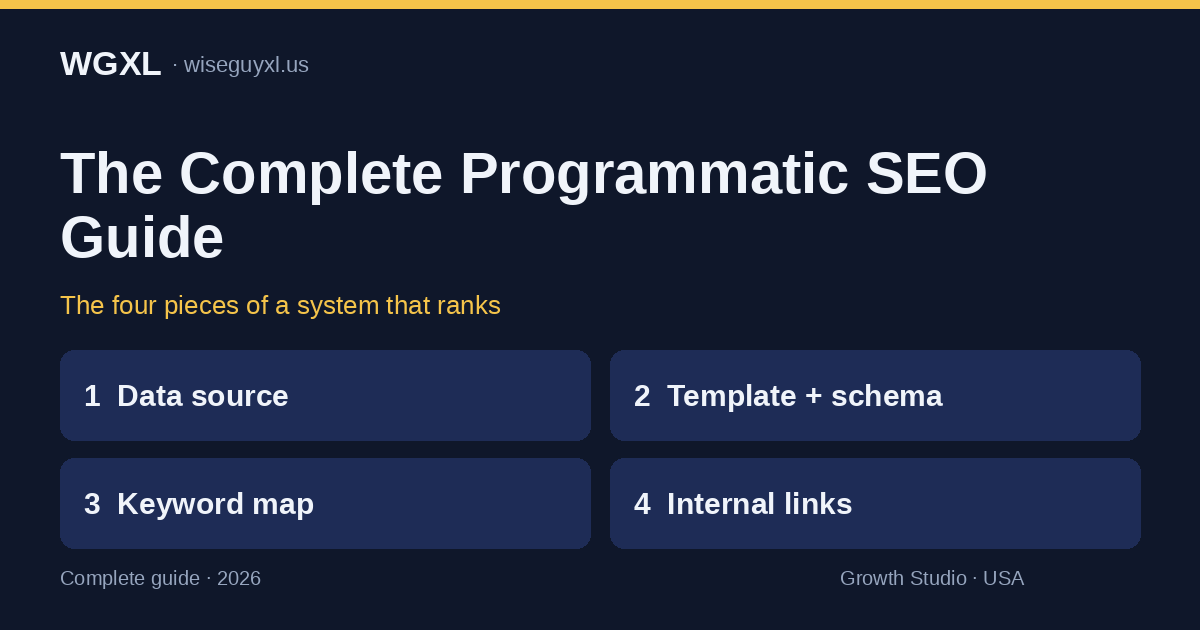
How programmatic SEO works: the four pieces
- A data source deep enough to make each page genuinely different — not just a list of names, but prices, features, local details, or original data.
- A template with dynamic H1-H3, meta tags that change with the data, and JSON-LD schema.
- A keyword map that assigns each page one clear search intent, validated for real volume (even ~50/month is worth it at scale). Start with free keyword research.
- Internal linking in a hub-and-spoke model so no page is an orphan and authority flows to the pillars and your money pages.
The 2026 rules: staying on the right side of Google
Volume is not the violation. Google targets volume combined with ranking-manipulation intent and little user value — mass AI generation without review, or template-with-variable pages at scale. Sites that generated thousands of near-identical pages saw ranking losses of 60-90% after the March 2026 update. Pages built on unique, verified data — real listings, live pricing, genuine local detail — continue to rank. The practical guardrail: unique data per page, editorial review, a duplication audit across the set, and a sensible publishing pace (start slow on a young domain).
Add AEO so AI engines cite you
Answer Engine Optimization structures pages so ChatGPT, Perplexity and Google AI Overviews quote them: a concise answer first, question-shaped headings and FAQs, credible sources, and freshness. Because AI citations overlap little with Google’s classic top 10, this is separate work — and it decays without periodic refreshes. See how programmatic SEO and AEO work together and how to rank in Google AI Overviews.
A step-by-step method
- Pick a page type with genuine demand (comparison, alternatives, integration, local, use-case).
- Build the data model — the unique fields each page will render.
- Validate keywords and intent; drop combinations with no demand.
- Write an answer-first template with schema and a quick-answer block.
- Plan internal links (up to pillar, down to spokes, siblings) and to your service pages.
- Publish in small batches; confirm indexing in Search Console before scaling.
- Measure, then refresh or prune what underperforms.
Related: our pSEO and AEO services explained, the best programmatic SEO agencies, and the results we’ve driven. Prefer done-for-you? See the service.
Frequently asked questions
Is programmatic SEO dead in 2026?
No. It’s penalized only when pages are thin and templated with no added value. Companies like Zapier and Airbnb show it works when each page carries real, unique data.
How many pages should I publish at once?
On a new domain, start with a small batch (roughly 1-3/day), confirm they index and perform, then ramp. Publishing thousands at once reads as a spam spike.
Do I need a developer?
Not necessarily — WordPress with a data source and a good template works. Frameworks like Next.js help at larger scale, and our software team can build the pipeline.
Want this done for you? Book a 30-minute strategy call.
By Shivam Singh, Founder, WiseGuy XL. Sources: Google Search Central spam policies (scaled content abuse, March 2026); WGXL client results, wiseguyxl.us.